The corporate apparel market is witnessing a significant shift toward technical performance wear, where the demand for a soft shell jacket custom logo has evolved from simple branding to a requirement for integrated weather protection. In an era where outdoor-to-office transitions are common, the softshell category has bridged the gap between heavy-duty alpine gear and professional corporate attire.
For procurement managers and brand owners, the challenge lies in balancing aesthetic customization with industrial-grade specifications. Selecting a garment that supports high-fidelity logo application without compromising the waterproof membrane or breathability rating is a critical technical hurdle. Poorly executed customizations often lead to leakage at the stitch points or peeling of thermal transfers in extreme cold.
This analysis examines the technical architecture of high-performance softshells, the engineering constraints of custom branding, and how to evaluate manufacturer capabilities to ensure that a custom-branded outerwear piece maintains its technical integrity in rugged environments.


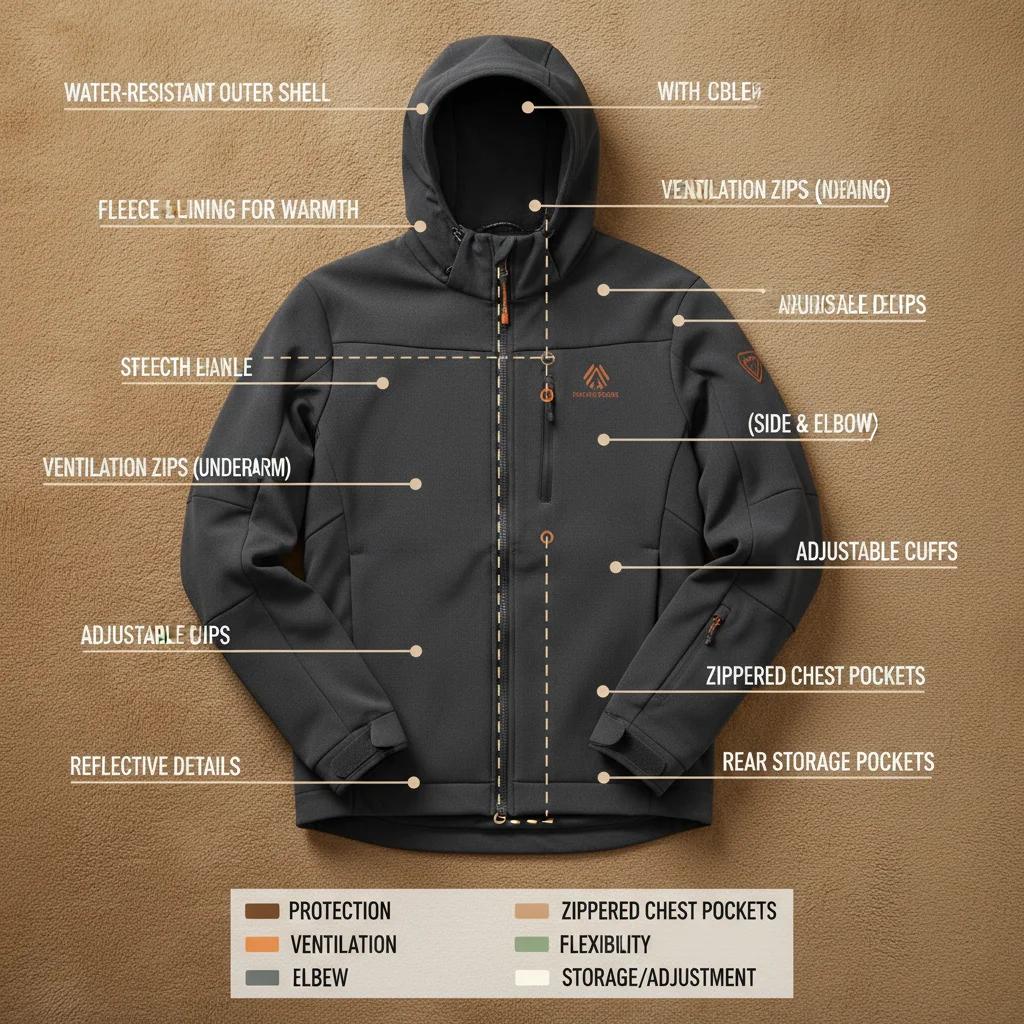
A professional softshell is not a single fabric but a multi-layered system. The outer face typically utilizes a tightly woven polyester or nylon blend, often treated with a Durable Water Repellent (DWR) coating to prevent saturation. Below this lies the membrane—the engine of the garment—which must be microporous to block liquid water while allowing water vapor (sweat) to escape.
The inner layer usually consists of a bonded fleece or a specialized thermal mesh. This bonding process is critical; if the adhesive is inconsistent, the garment will suffer from delamination, causing "bubbles" to appear on the surface and reducing the thermal efficiency of the piece.
When evaluating a technical jacket, the waterproof rating is the primary benchmark. A rating of 15,000mm indicates that the fabric can withstand significant water pressure before leaking, making it suitable for heavy snow or prolonged rain. This is a substantial upgrade over standard 5,000mm corporate shells, which are only "water-resistant."
Breathability, measured in g/m²/24h, is equally vital. An 8,000g rating ensures that during high-intensity activity—such as skiing or site inspections—moisture is transported away from the body. Without this, the wearer experiences the "trash bag effect," where condensation builds up inside the jacket, leading to rapid chilling.
Thermal regulation is often achieved through advanced fills. For instance, 3M Thinsulate™ provides a high warmth-to-weight ratio, allowing the jacket to maintain a sleek silhouette while protecting the wearer in temperatures as low as -15°C. This prevents the bulkiness associated with traditional polyester padding.
Applying a custom logo to a technical softshell presents a direct conflict between branding and performance. Traditional embroidery involves piercing the fabric with thousands of needles, which creates micro-holes in the waterproof membrane. Without corrective measures, these holes become leak points.
Alternatively, high-frequency welding or silicone heat transfers are used for a seamless finish. These methods bond the logo to the surface using heat and pressure, maintaining the fabric's structural integrity and providing a modern, minimalist aesthetic preferred by high-end winter sports collections.
The difference between standard corporate outerwear and professional technical gear is most evident when analyzed through normalized performance scores. While basic shells focus on visual consistency, technical gear prioritizes the intersection of thermal retention and moisture management.
The following data represents a normalized engineering assessment comparing different tiers of softshell configurations across critical performance dimensions.
In real-world alpine scenarios, the effectiveness of a technical shell is tested by its ability to withstand abrasion and maintain seal integrity. For professionals operating in snowy conditions, features like taped seams are non-negotiable. Taped seams seal every needle hole with waterproof tape, preventing moisture from seeping through the construction lines during prolonged exposure to wet slush.
Furthermore, safety integrations such as reflective piping and optional RECCO® reflectors transition the garment from simple apparel to a piece of safety equipment. These additions are particularly critical for corporate teams operating in backcountry or industrial winter environments where visibility and rescue capabilities are primary risk-management factors.
The industry is moving toward "smarter" textiles that offer adaptive thermal regulation. We are seeing a shift from static insulation to phase-change materials (PCMs) that can absorb and release heat based on the wearer's body temperature and external environment.
Sustainability is also driving material innovation. Recycled polyester membranes are becoming the standard, moving away from PFC-based DWR coatings to environmentally friendly alternatives that maintain water repellency without persistent bioaccumulative toxins.
Customization is becoming more integrated. Rather than just adding a logo, brands are now requesting custom-engineered fabric weights and hybrid constructions—where different panels of the jacket have different breathability ratings—to optimize the garment for specific high-stress body zones.
Selecting the right manufacturing profile depends on the intended use case and the environmental stress the garment will face. A corporate promotional shell requires different specifications than a professional-grade alpine jacket.
The matrix below outlines the typical technical configurations used in the woven clothing industry, helping buyers align their soft shell jacket custom logo project with the correct performance tier.
It is essential to verify that the chosen configuration matches the intended operating temperature and moisture exposure to avoid premature garment failure.
| Configuration Profile | Waterproof Rating | Insulation Type | Recommended Use Case |
|---|---|---|---|
| Basic Corporate | 5,000mm | Standard Fleece | Light Rain / Urban |
| Standard Technical | 10,000mm | Synthetic Fill | Mixed Outdoor/Work |
| High-Duty Alpine | 15,000mm+ | 3M Thinsulate™ | Extreme Winter / Ski |
| Professional Shell | 20,000mm | Gore-Tex / Hybrid | Mountain Expeditions |
| Active Mid-Layer | 3,000mm | Lightweight Mesh | High-Aerobic Activity |
| Industry Baseline | 8,000mm | Bonded Polyester | General Industrial Use |
A 15,000mm rating means the fabric can withstand 15,000mm of water column pressure before leaking. In practical terms, this allows the wearer to stay dry during heavy snowfall or prolonged exposure to wet slush, which is critical for safety and thermal maintenance in alpine environments where moisture leads to rapid heat loss.
Yes, standard embroidery pierces the membrane. To prevent this, professional manufacturers use back-taping or seal-patching, applying a waterproof heat-seal film to the interior of the jacket at the logo site. This maintains the waterproof barrier while allowing for high-fidelity brand customization.
Unlike bulky traditional fills, 3M Thinsulate™ uses micro-fibers to trap more heat while remaining thin. This provides superior thermal regulation and warmth-to-weight ratio without restricting the wearer's mobility, which is essential for activities like skiing or active professional work.
Waterproof fabric only protects the panels; water can still leak through the needle holes created during stitching. Taped seams involve applying a waterproof tape over every seam using heat and pressure, creating a fully impenetrable barrier against liquid moisture.
Yes, RECCO® reflectors can be added as a customizable feature. This passive rescue system allows professional search-and-rescue teams to locate users in avalanche or backcountry emergencies more efficiently, providing a critical safety layer for high-end outdoor collections.
For large-scale manufacturing involving technical membranes and custom branding, the standard lead time is typically between 60 to 120 days after the pre-production (PP) sample is confirmed. This allows for rigorous testing of waterproof membranes and seam integrity.
The transition toward technical corporate outerwear requires a shift in procurement logic—from prioritizing purely visual brand impact to evaluating the engineering of the garment. The integration of a soft shell jacket custom logo must be viewed as a technical challenge that requires specific manufacturing solutions like back-taping to maintain waterproof integrity.
By aligning material specifications—such as 15,000mm waterproof ratings and 3M Thinsulate™ insulation—with actual environmental operating conditions, brands can deliver outerwear that serves as both a professional statement and a critical piece of protective equipment.

If you are interested in our products, you can choose to leave your information here, and we will be in touch with you shortly.